Specify a cleanroom by the governing standard, particle size, occupancy state and acceptance evidence. ISO classes describe airborne particle concentrations. EU GMP grades add requirements for sterile-medicinal-product operations. A panel test report supports the supplied component; room classification and qualification require evidence from the completed installation and its intended use.
What does an ISO cleanroom class actually describe?
ISO 14644-1:2015 classifies air by the concentration of particles at specified sizes. Its scope does not identify whether those particles are viable organisms, chemicals or a particular material. A lower class number means a lower permitted concentration at the same size threshold.
ISO currently lists the 2015 edition as published and under systematic review. Write the required edition into the project documents and check its status when the specification is approved.
| ISO reference | Particles ≥0.5 μm per m³ | FDA guidance context | Still specify |
|---|---|---|---|
| ISO 5 | 3,520 | Exposed aseptic operations | Sampling locations and process state |
| ISO 7 | 352,000 | Adjacent supporting area, minimum recommendation | Risk and relationship to the critical area |
| ISO 8 | 3,520,000 | Less critical activities, such as equipment cleaning | The actual operation and acceptance plan |
Values: FDA aseptic-processing guidance, Table 1 and Section IV (2004). The table’s footnote specifies measurements near exposed materials during activity. These examples do not assign a class to every room or industry.
How do EU GMP Grades A–D differ from ISO classes?
Where EU GMP Annex 1 applies, Grades A–D belong to a wider contamination-control framework. Matching a particle concentration alone does not assign a GMP grade. Annex 1 separates classification criteria in Table 1 from routine particle-monitoring limits in Table 5.
| Grade | At rest | In operation | Condition note |
|---|---|---|---|
| A | 3,520 | 3,520 | Same particle ceiling in both states |
| B | 3,520 | 352,000 | Different ceilings for the two states |
| C | 352,000 | 3,520,000 | Different ceilings for the two states |
| D | 3,520,000 | Not predetermined | Manufacturer sets limits from risk assessment and routine data |
These are Table 1 classification values for one particle-size threshold. Grade D still requires defined operational control. Use Table 5 separately for routine particle monitoring.
A room brief should identify the process, exposed product and applicable jurisdiction before choosing a grade. Keep the regulatory requirement separate from a supplier’s component description.
Why must the test state be stated?
Under Annex 1, at-rest conditions have HVAC running, production equipment installed but not operating, and no personnel. In-operation conditions include functioning equipment and the specified personnel working at the defined operating capacity.
Put the state beside the class or grade in the room schedule. Record the agreed equipment arrangement, personnel number and process activities in the protocol. This gives the owner, tester and suppliers one acceptance target.
What is the difference between particle and microbial results?
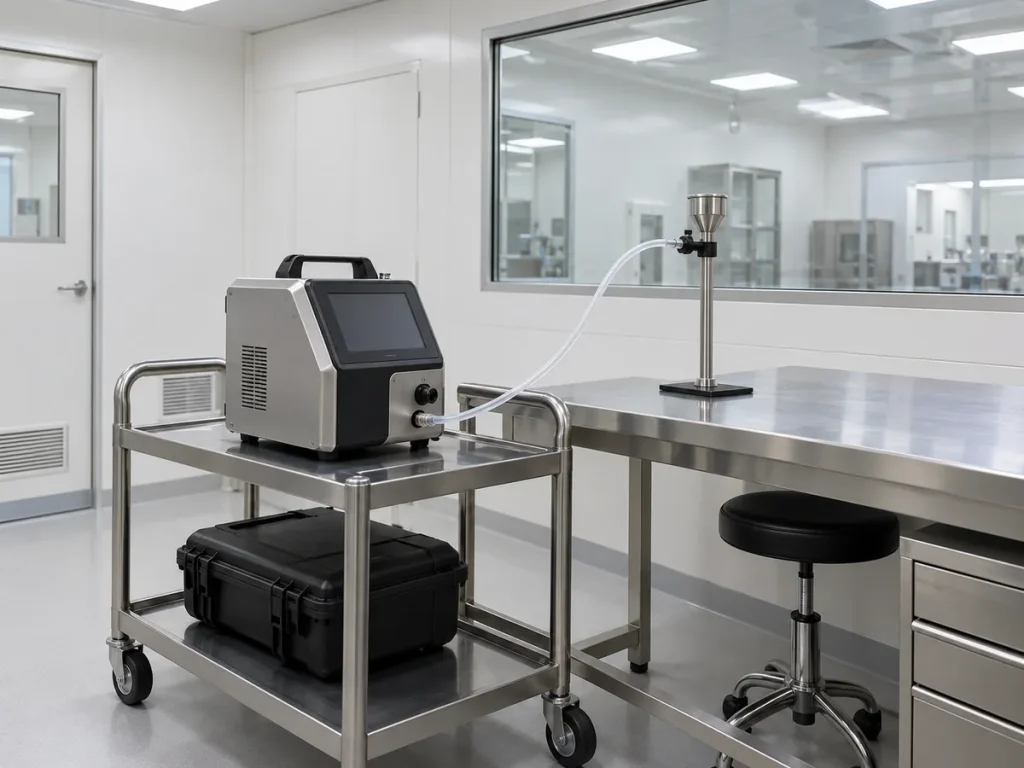
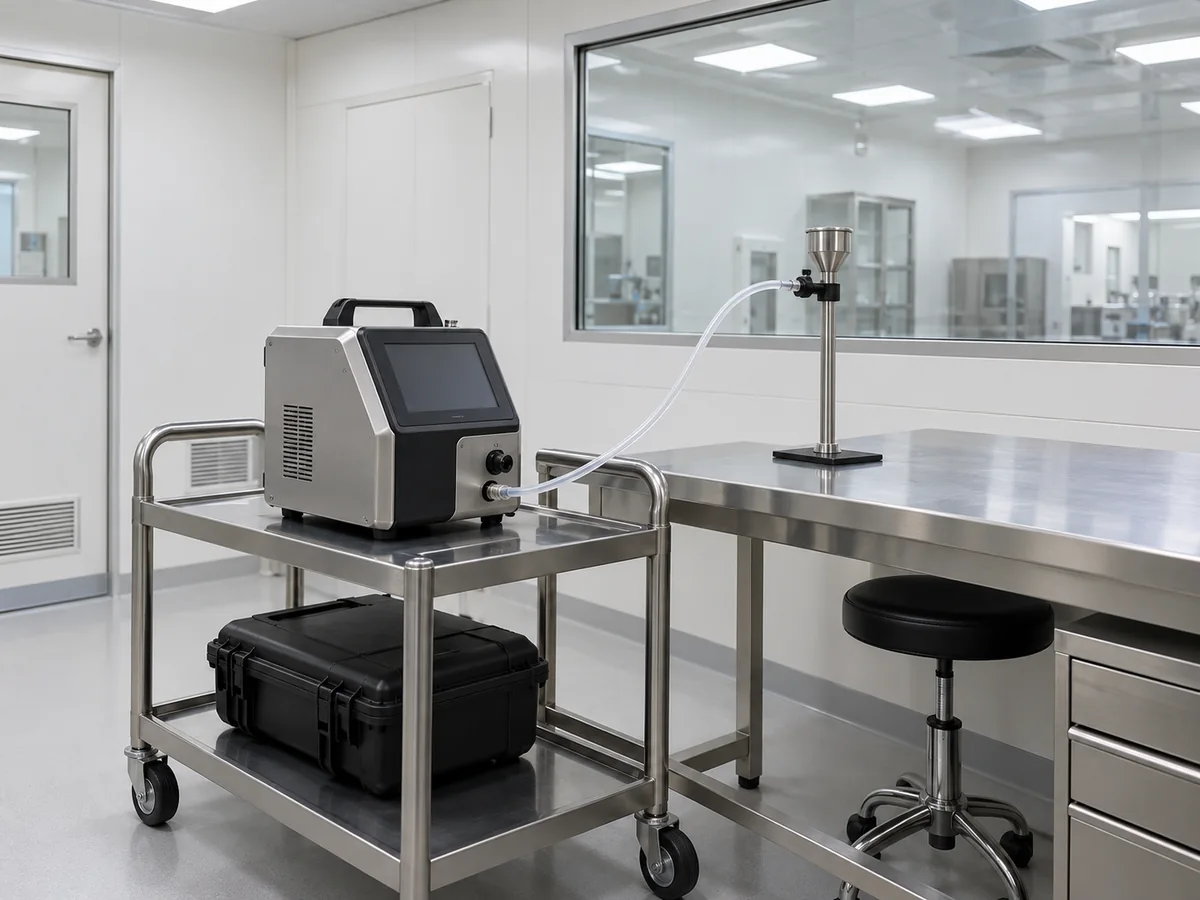
Total-particle counting, often called non-viable monitoring, measures particles by size; the instrument does not determine biological viability. Viable monitoring investigates recoverable organisms using defined microbiological methods, often reporting colony-forming units (CFU). A particle-counter result does not establish microbial control or sterility.
Keep each result with its sampling method, location, operating condition and acceptance criterion. Avoid combining particle counts and microbial results into one unnamed “cleanliness score”.
Does classification replace qualification or monitoring?
Classification is one part of qualification. Qualification brings together evidence that the specified installation performs as intended. Routine monitoring checks continued control during use; the plan sets sampling locations, frequency, limits, review and response.
ISO 14644-2:2015 addresses monitoring plans related to airborne particle cleanliness. A single passing classification report cannot substitute for that continuing programme. Agree who prepares protocols, performs tests, reviews deviations and approves release.
What should a buyer put in the enclosure brief?
Turn the environmental requirement into a coordinated supply brief before comparing panel quotations:
- Room requirement: application, governing standard and edition, class or grade, particle sizes and specified states.
- Acceptance plan: room boundaries, sampling and test responsibilities, instruments, records and approval authority.
- Enclosure interfaces: panel schedule, finishes, joints, door and window openings, penetrations, cleaning exposure and ceiling supports.
- Evidence schedule: the component drawings, material information, applicable reports and installation records required for the quoted construction.
Use the panel standards and documentation guide to separate component evidence from facility requirements. Match available records in the AILV test-report library to the named model. Confirm the qualification-support scope with the owner and specialist team; component documents do not classify an installed room.
Prepare a comparable enclosure enquiry
Send the room schedule, drawings and required document list. AILV can review the wall, ceiling, door and window package within the agreed supply scope.
Prepare Your Enclosure BriefCleanroom classification FAQ
Is an ISO class the same as a GMP grade?
No. An ISO class specifies airborne particle concentration. EU GMP grading adds process-specific requirements; particle results alone do not assign a GMP grade.
Is a class number enough without a test state?
Specify the state with the class. A result obtained without operators cannot be treated as proof of the same performance during production.
Does a particle counter measure viable microorganisms?
A particle counter reports particles by size, not their viability. Microbiological assessment needs its own sampling methods and criteria.
Does Annex 1 give Grade D a fixed in-operation particle limit?
No fixed in-operation value is set by Annex 1. The manufacturer establishes limits from risk assessment and routine data.
Can routine monitoring replace initial qualification?
Qualification and monitoring serve different purposes. Establish the installation’s performance against the acceptance plan, then monitor continued control under the defined operating conditions.
Which documents should accompany an enclosure quotation?
Request drawings, component specifications and applicable reports for the offered construction. Identify the room-classification protocol, facility qualification and approval responsibilities separately in the project brief.