What is a portable cleanroom?
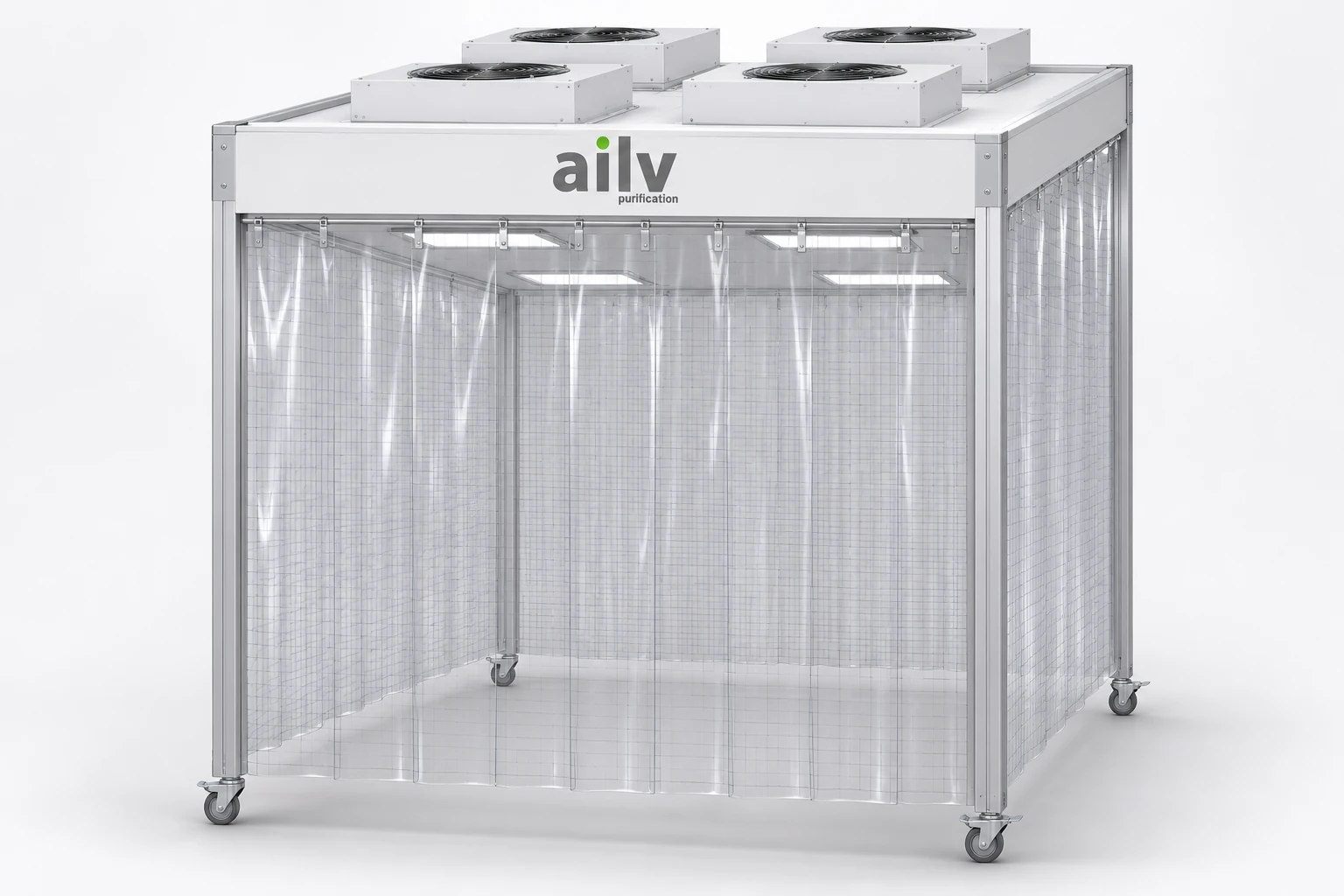
A portable cleanroom, also called a softwall cleanroom or clean booth, provides a local filtered-air workspace using a supporting frame, overhead fan-filter units and configurable perimeter screens. Specify the frame, screens, airflow arrangement and access together. AILV coordinates the proposed enclosure and equipment package around the process and site requirements.
For a mobile cleanroom, include the intended relocation route and any optional casters in the configuration. Choose a booth for local process protection or an upgrade within an existing production space.
Which components should a portable clean booth include?
Softwall cleanroom enclosures offer flexible access and a configurable footprint. Transparent perimeter screens maintain visibility, while the overhead fan-filter arrangement and lower return or exhaust path are selected for the work inside the booth.
| Item | Configuration to discuss | Procurement input | Confirm with the proposal |
|---|---|---|---|
| Frame | Extruded aluminum, stainless steel square tube or powder-coated steel | Layout, spans, environment and finish | Sections, connections and support arrangement |
| Perimeter | Transparent screens, acrylic panels or grid curtains | Visibility, access and cleaning exposure | Material specification, joints and any ESD documentation |
| FFUs and filters | Overhead fan-filter units with the selected filtration package | Process protection, working height and required cleanliness | Unit arrangement, filter documentation, airflow and acceptance checks |
| Ceiling and lighting | Ceiling infill, lighting and equipment interfaces | Illumination, maintenance access and service routes | Support responsibility and electrical scope |
| Access | Strip or curtain entrances and agreed transfer openings | Personnel, materials and equipment movement | Opening dimensions and operating procedure |
| Mobility | Fixed feet or optional casters | Floor condition, route, doorway clearance and relocation frequency | Support, restraint, handling and service-disconnection plan |
| Controls | Fan, lighting and monitoring functions selected for the package | Power supply, alarms and required operating modes | Controls, sensors and commissioning responsibility |
The selected curtain or acrylic specification determines any antistatic characteristics. Match the material evidence to the application instead of relying on appearance.
How does a softwall clean booth compare with a hardwall modular cleanroom?
Compare the enclosure around the operation, access and relocation plan. The AILV hardwall modular cleanroom system uses coordinated wall panels and an aluminum base frame; this clean booth uses a framed local workspace with configurable perimeter screens.
Is a compact clean-air hood the same as a walk-in clean booth?
A compact hood protects a bench-sized work area accessed from outside. A walk-in booth encloses space for people, process equipment and material movement. Check the working volume, access and airflow direction before comparing the two. This page describes AILV framed clean-booth configurations; the hardwall modular alternative is compared below.
| Decision | Portable / softwall clean booth | Hardwall modular enclosure | Buyer check |
|---|---|---|---|
| Boundary | Flexible screens or a selected transparent perimeter | Panel walls, coordinated doors and observation glazing | Cleaning, containment, access and operating needs |
| Layout change | Review the frame, screens and overhead equipment together | Review wall modules, base and opening interfaces together | What can be retained, altered or replaced |
| Relocation | Optional mobile configuration and planned service disconnection | Base-framed module with a project handling plan | Route, structure, supports and reconnection |
| Acceptance | Checks for the agreed booth and operating conditions | Checks for the agreed room and operating conditions | Classification, testing state and records in the specification |
Where are portable cleanrooms used?
Discuss local protection for electronics and optical assembly, inspection, laboratory handling or selected medical-device operations. The process determines the enclosure and environmental requirements. Record exposed product surfaces, personnel activity, heat sources, equipment dimensions and transfer routes.
- Define the work zone. Send the booth footprint, clear working height and process layout.
- Choose the enclosure. Confirm the frame, screens, access and any mobile arrangement.
- Coordinate services. Identify FFU, lighting, electrical and monitoring responsibilities.
- Agree installation and checks. Set the site conditions, assembly scope, classification requirements and handover records.
- Plan future moves. Check the route, isolate services, protect components and repeat the agreed checks after reassembly or relocation.
For the wider enclosure and service interfaces, see cleanroom systems and solutions. For wall-panel arrangements, compare the AILV product ranges and door and window interfaces.
What information is needed for a portable cleanroom quote?
Send a dimensioned layout, process description, site photographs, required environmental conditions, operating state, frame and perimeter preferences, access dimensions, electrical supply and relocation needs. Mark whether the quotation should cover enclosure components, FFUs, filters, controls, installation and acceptance support.
Compare equivalent scopes when choosing a portable cleanroom supplier. Ask for a softwall cleanroom price with a breakdown of equipment, drawings, packing, delivery and installation. Confirm which documents are included and list any exclusions. Use the general quotation input checklist, and list softwall screens, FFUs and any casters separately for the selected clean booth.
Portable and softwall cleanroom questions
Are portable cleanrooms, softwall cleanrooms and clean booths the same product?
These terms often describe a framed local clean-air workspace with configurable perimeter screens. Use the actual construction, filtration, access and support arrangement to compare products. Mobile cleanroom describes the selected relocation configuration.
Can a clean booth be fitted with wheels?
Casters can be discussed as an option. Confirm the unit configuration, supports, restraints, floor and route with the handling plan. Disconnect services and complete the agreed checks before returning the booth to use after a move.
What ISO class should be specified for a portable cleanroom?
Select the target class from the process requirement. ISO 14644-1 classifies air by particle concentration; the words portable, softwall or HEPA do not assign a class. State the required class, particle size, occupancy state and acceptance method in the specification, and verify the completed arrangement under those conditions. See the AILV standards and classifications FAQ for the evidence boundary.
What information is needed to compare clean booth quotations?
Use the same layout, clear height, frame and screens, access, filtration, controls, electrical scope, installation and acceptance requirements. Identify the mobile configuration and any service-disconnection or rechecking work in both proposals.
How does a positive-pressure clean booth work?
For a product-protection softwall booth, overhead fan-filter units supply filtered air downward over the work zone. Air leaves through planned lower perimeter openings or a defined return/exhaust route, supporting an outward-flow arrangement. Size the FFU coverage, supply volume and relief path together. Flexible curtains allow air to escape, so a specified room pressure differential needs a suitable enclosure and measured confirmation. Check the flow pattern with the actual equipment and operators in place.
Which pre-filter, HEPA or ULPA filter should be specified?
State the pre-filter arrangement and rating, final-filter grade, test method and replacement access. MERV 8 is a pre-filter option to name when required, rather than a universal included specification. EPA describes HEPA filtration as at least 99.97% capture at 0.3 μm under its definition. For a requested ULPA option, identify the offered efficiency, particle size, test standard and filter report. Match the fan capacity, seals and installed checks to that package. Filter efficiency alone does not establish the booth’s ISO class.
Does portable mean moving a complete booth on wheels?
A caster-equipped mobile booth may be designed for repositioning as an assembled unit, subject to stability, the route and service connections. A larger portable system may instead move as sections for reassembly. Confirm the permitted handling method and whether ceiling equipment and filters stay fitted. Disconnect services, protect components and complete the agreed cleaning and post-move checks before use.
How quickly can a portable cleanroom be installed or expanded?
Assembly time depends on the frame size, overhead equipment, wiring, delivery format, site access and available crew. Request a sequence covering mechanical assembly, electrical connection, cleaning and acceptance testing. Prefabricated sections can simplify assembly. Expansion still requires compatible frame and ceiling modules, revised FFU coverage, service capacity and repeat checks; confirm these provisions before ordering. The quotation should state the project schedule rather than assume a fixed installation time.
What determines portable cleanroom cost and budget?
Price follows the working footprint and height, frame and screens, FFUs and filters, controls, electrical work, installation, transport and acceptance documentation. Compare compact hoods per complete unit; compare walk-in booths on the same included scope before using a floor-area price. For a limited budget, define the smallest protected zone that fits the process and check total installed cost. Request separate options for casters, extra modules and upgraded filters so each proposal can be compared.


