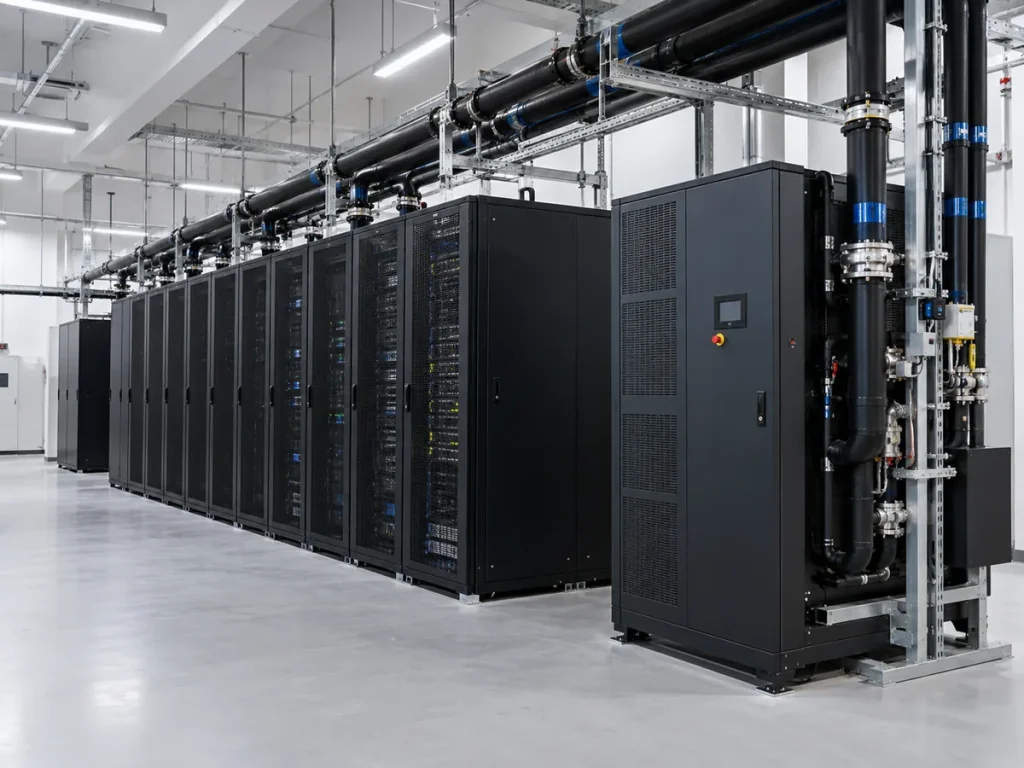
Two announcements in November put coolant distribution units (CDUs) within a wider AI data center cooling design. Daikin Applied introduced a 60 MW reference architecture on 10 November, while Delta announced new CDU and cooling exhibits on 11 November ahead of SC26. Both bring attention to the interfaces between computing equipment, liquid circuits and facility cooling.
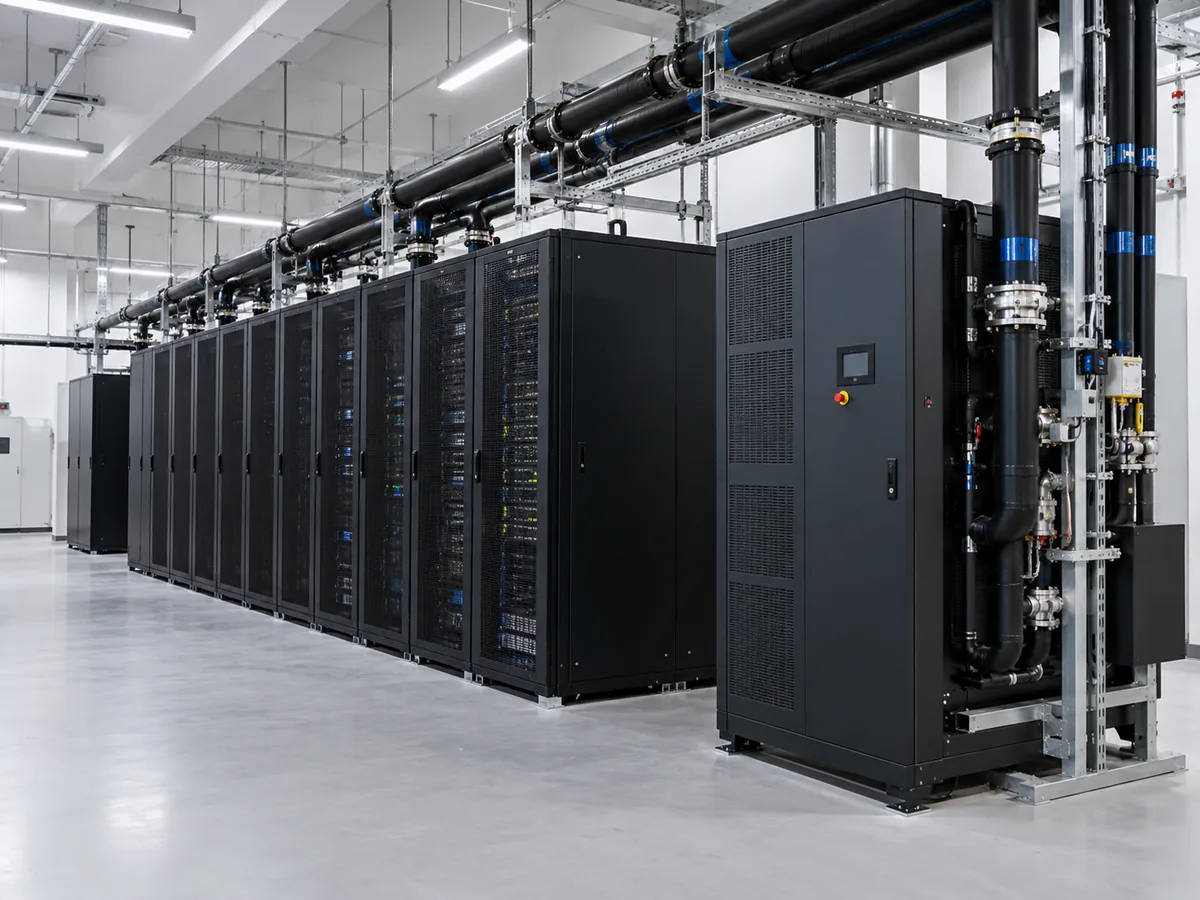
Daikin sets out a two-temperature-loop reference design
Daikin Applied’s D60-W reference architecture covers a 60 MW IT load across six deployable units. The company assigns 92% of that design load to liquid cooling and 8% to air cooling. A higher-temperature loop serves CDUs, while a separate lower-temperature loop serves air-cooling rack containment units. These proportions describe this particular blueprint.
The announcement connects rack cooling with chillers, dry coolers and supervisory controls. Daikin also states that its CDU and data center dry cooler remain under development, with availability targeted for the second half of 2027. A published reference architecture therefore needs a component-availability review when used for a project schedule. The global release page is dated 11 November; its announcement dateline is 10 November. Read Daikin’s official release.
Delta previews rack and row CDU options for SC26
Delta’s 11 November release lists an 800 VDC-powered, 2.5 MW in-row liquid-to-liquid CDU among its planned SC26 exhibits. The portfolio also includes a 4U in-rack CDU rated up to 200 kW and an in-row design rated up to 2 MW at a 3°C approach temperature.
Delta says visitors can view its cooling portfolio in Chicago on 17–19 November 2026. As of this article’s review date, that exhibition is still upcoming. The stated capacities concern different equipment configurations; a purchase comparison needs the selected model’s operating conditions, electrical supply and service requirements. Read Delta’s official announcement.
Where the CDU sits in the cooling chain
A CDU manages coolant delivery near IT equipment. In a liquid-to-liquid arrangement, a heat exchanger transfers heat between the technology cooling system (TCS) and the facility water system (FWS), keeping the two fluid circuits separate. The chosen equipment regulates the secondary circuit’s temperature, flow and pressure. A liquid-to-air CDU instead rejects heat into room air, so the facility still needs a way to remove that heat. Vertiv’s technical introduction explains these arrangements.
SIMPLIFIED HEAT-TRANSFER PATH / LIQUID-TO-LIQUID
What buyers should carry into the project brief
AILV’s engineering perspective: these announcements make early interface coordination a practical procurement priority. Before finalizing an enclosure layout, ask the cooling designer and equipment supplier to agree four items:
- A common rating basis. Identify the model, duty point, inlet temperatures, coolant, flow and pressure requirements. Compare proposals against the same operating brief.
- The remaining air-cooling duty. Mark which equipment loads use liquid cooling and which remain on room or rack air cooling. Reflect both paths in the coordinated layout.
- Access and pipe interfaces. Reserve equipment-entry and maintenance space. Coordinate pipe supports, insulation allowances, wall openings and the responsibility for sealing each penetration.
- Delivery and handover boundaries. Name the parties responsible for flushing, fluid approval, leak checks, controls integration and acceptance records. Match the construction schedule to confirmed equipment availability.
For enclosure planning, AILV supplies wall and ceiling panels with coordinated doors, windows and service openings within the agreed package. Use the data center enclosure overview to define that scope, then check the panel pipe-opening guide against the cooling drawings.
Preparing a data center enclosure enquiry? Send the room layout, cooling-equipment arrangement, opening schedule, panel requirements and destination through the AILV project enquiry form. Identify the enclosure supply and cooling-equipment responsibilities separately in the brief.
Sources and review date
- Daikin Applied: 60 MW AI Factory Cooling Reference Architecture — announcement dateline 10 November 2026; global page 11 November.
- Delta: SC26 power and cooling portfolio announcement — 11 November 2026.
- Vertiv: Understanding Coolant Distribution Units for Liquid Cooling — technical background.
Reviewed 16 November 2026. Manufacturer figures and future availability are attributed to the named releases. Procurement observations are AILV editorial analysis, not independent equipment test results.